An LED mirror cabinet may look like a simple bathroom product, but commercial buyers rarely have simple requirements.
A hotel may need a refined appearance and consistent dimensions across hundreds of rooms.
An apartment developer may focus on cost, installation efficiency, and reliable bulk delivery.
A distributor may need several sizes and configurations for different customers.
A bathroom brand may want a completely customized product under its own name.
These buyers are purchasing the same product category, but they are not looking for the same solution.
That is why custom LED mirror cabinets are becoming increasingly important in the B2B market.
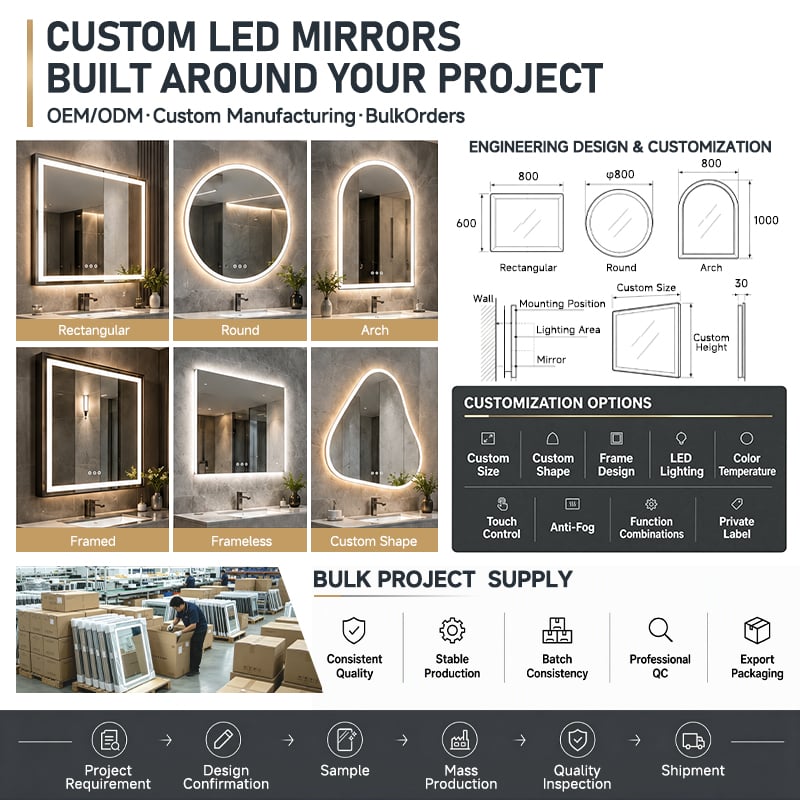
Instead of forcing every project to use one standard model, manufacturers can adapt the cabinet around the buyer's market, installation conditions, and commercial positioning.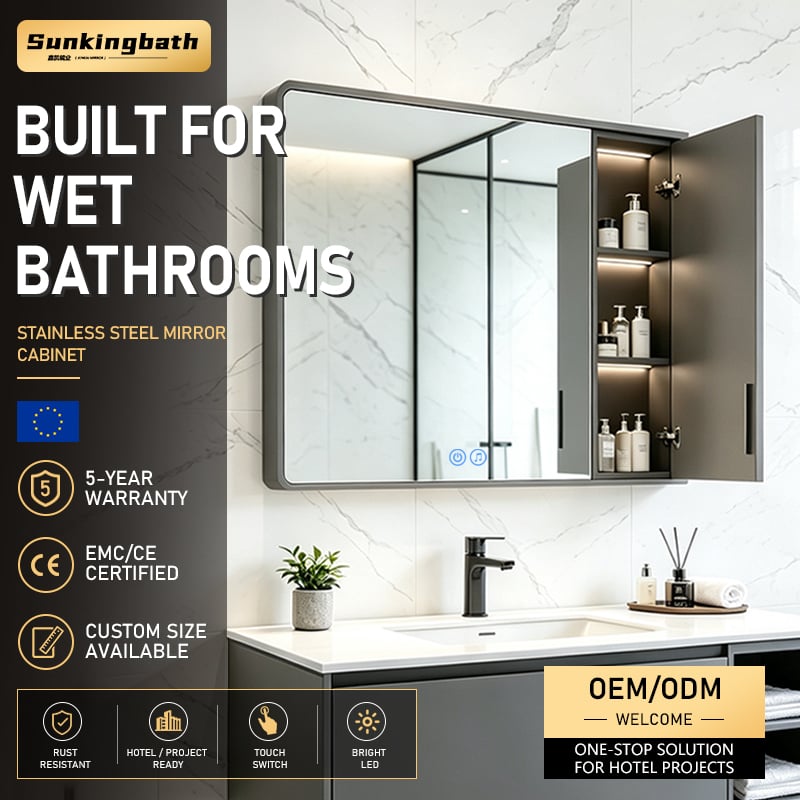
For a professional project, customization does not necessarily mean adding more functions.
Sometimes the most valuable change is simply getting the structure right.
For example, a project may require a cabinet that fits precisely above a specific vanity. Another may have limited wall depth. A hotel designer may need the cabinet to align with existing tiles or lighting.
Small dimensional differences can create problems during installation.
A factory capable of OEM and ODM production can adjust:
Overall width
Cabinet height
Depth
Door configuration
Internal storage
Mirror proportion
Mounting structure
Electrical component position
Lighting arrangement
This gives project buyers greater freedom during the design stage.
A useful advantage of working with an experienced manufacturer is that one basic concept can often be developed into several versions.
For example, a distributor could create:
Entry Version
Essential LED lighting and storage for price-sensitive projects.
Standard Version
LED lighting, anti-fog, touch control, and improved cabinet configuration.
Premium Version
Adjustable lighting, smart functions, Bluetooth audio, charging ports, and upgraded materials.
The core structure can remain recognizable while the configuration changes according to the target market.
For distributors and private-label brands, this creates a more organized product portfolio without requiring completely different manufacturing partners.
In hospitality projects, the most impressive specification is not always the most practical one.
A hotel may have hundreds of bathrooms. If every room uses a different product configuration, installation, maintenance, spare parts, and staff training become more complicated.
For this reason, many hotel projects benefit from standardized product families.
A manufacturer can produce the same visual design in different sizes while maintaining consistent:
Mirror quality
LED appearance
Frame finish
Cabinet construction
Touch controls
Installation method
Packaging
This approach makes procurement and future replacement easier.
For hotel contractors and developers, consistency can be just as important as appearance.

When purchasing hundreds of LED mirror cabinets, the initial quotation is only one part of the total cost.
Buyers also need to consider:
Product cost + transportation + installation + replacement + maintenance + project delay
A slightly cheaper cabinet may become expensive if it creates installation problems or has a high damage rate during shipping.
A properly engineered product can help reduce these hidden costs.
This is especially relevant for overseas projects where returning damaged products or ordering replacement units can be time-consuming and expensive.
For a bathroom brand, selling a standard factory model can make it difficult to build a distinctive product range.
OEM production provides another option.
A brand can define the product according to its own market positioning.
For example:
A minimalist European collection
A premium hotel-oriented series
A cost-effective apartment range
A modern North American collection
A smart bathroom product line
The manufacturer handles production while the brand controls the product concept, specifications, packaging, and market presentation.
This creates a more sustainable relationship than simply purchasing whichever standard model happens to be available.
Lighting should not be treated as an afterthought.
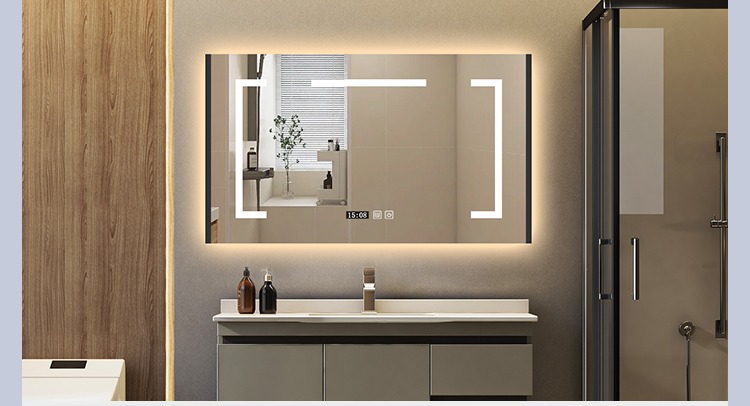
The position and appearance of LED illumination can significantly influence how a mirror cabinet looks when installed.
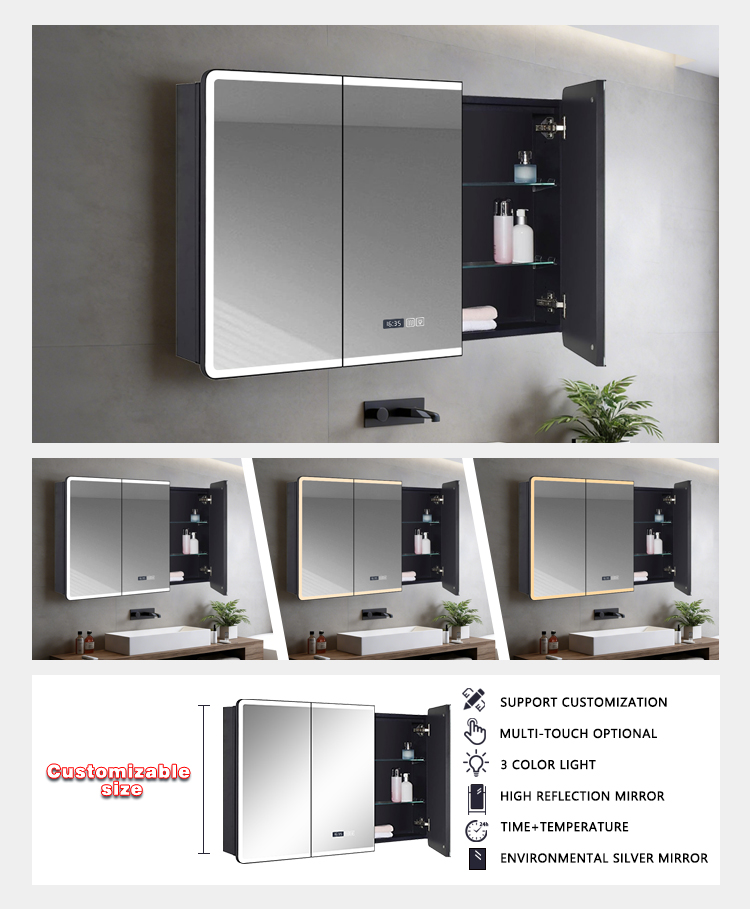
Depending on the project, lighting can be designed as:
Front illumination
Back illumination
Perimeter lighting
Internal cabinet lighting
Combined lighting
Color temperature can also be selected according to the intended atmosphere.
Warm lighting can suit hospitality-oriented interiors, while neutral lighting is commonly suitable for residential and commercial environments.
For premium projects, adjustable color temperature and dimming can provide additional flexibility.
Smart features can add value, but B2B buyers should consider whether each function has a clear purpose.
For different projects, available options may include:
Useful for environments where condensation can affect mirror visibility.
Provides a clean interface without requiring a conventional wall switch.
Can automatically activate lighting in selected applications.
Adds practical value for modern residential and hospitality environments.
Can be incorporated into premium product configurations.
Suitable for smart bathroom concepts where additional information is part of the user experience.
The right combination depends on the project rather than simply adding every available feature.


The cabinet itself deserves as much attention as the LED system.
Commercial bathrooms can experience frequent cleaning, humidity, temperature changes, and continuous daily use.
Material selection can therefore affect:
Structural stability
Corrosion resistance
Surface appearance
Cleaning requirements
Product lifespan
Depending on the application, manufacturers may use aluminum, stainless steel, moisture-resistant boards, or other suitable materials.
For large projects, material specifications should be confirmed before production rather than left to assumption.
For B2B customers, the first sample is not simply a demonstration product.
It becomes the reference point for future manufacturing.
A professional OEM process normally involves:
Requirement confirmation
↓
Engineering evaluation
↓
Sample development
↓
Function and appearance approval
↓
Production specification confirmation
↓
Mass production
↓
Inspection
↓
Export packaging
This process is especially useful for buyers who plan to place repeat orders.
Once the specifications are confirmed, future production can follow the approved standard rather than starting the design process again.

Mirror products require careful handling during transportation.
For international shipments, packaging needs to protect both the glass surface and the cabinet structure.
Depending on order requirements, packaging solutions can include:
Reinforced foam
Multi-layer cartons
Corner protection
Individual product protection
Wooden crates
Customized shipping marks
For large projects, packaging is not simply a logistics detail.
If 2% or 3% of a large shipment arrives damaged, the replacement process can affect installation schedules and project budgets.
Good packaging is therefore part of good project management.

Custom products require more coordination than standard catalog products.
The sales team needs to understand the buyer's requirements.
The engineering team needs to evaluate feasibility.
The production team needs to reproduce the approved design.
The QC team needs to verify consistency.
The packaging team needs to protect the finished product.
When these departments work within one manufacturing system, customization becomes easier to control.
With more than 30 years of mirror manufacturing experience, we support OEM/ODM customers across different markets and applications, including hotels, apartments, distributors, contractors, bathroom brands, and private-label businesses.
Our experience covers not only product manufacturing, but also the practical requirements involved in international B2B supply.
Custom LED mirror cabinets can fit different purchasing models.
Develop one approved model and manufacture it consistently for the entire project.
Create a standardized product suitable for multiple residential units.
Build several configurations and sizes around one product platform.
Develop private-label products with customized functions and packaging.
Source directly from the factory and reduce unnecessary supply-chain layers.
Develop differentiated models instead of competing only on standard catalog products.
The commercial market is moving toward products that are easier to integrate into different interior projects.
For LED mirror cabinets, that means flexibility in dimensions, materials, lighting, functions, branding, and packaging.
The manufacturer is no longer simply a supplier of finished products.
For serious B2B buyers, the better partner is a factory that can participate in product development, understand project requirements, maintain production consistency, and support repeat orders.
That is where OEM and ODM manufacturing becomes valuable.
If you are developing a hotel bathroom collection, sourcing for an apartment project, expanding a distribution catalog, or building a private-label bathroom brand, a customized LED mirror cabinet can provide considerably more flexibility than a standard off-the-shelf model.
Our factory supports OEM/ODM development, custom dimensions, lighting configurations, smart functions, branding, packaging, quality inspection, and bulk production.
With more than three decades of manufacturing experience, we work with B2B customers looking for a long-term production partner rather than a one-time supplier.
Have a product drawing, reference photo, specification, or project quantity? Send it to us. Our team can evaluate the requirements and develop a suitable LED mirror cabinet solution for your market.
Dimensions, cabinet structure, mirror shape, lighting configuration, materials, smart functions, hardware, logo, packaging, and other specifications can be customized according to project requirements.
Yes. Custom dimensions and standardized configurations make them suitable for hotel rooms, serviced apartments, resorts, and other hospitality projects.
Yes. Multiple sizes can be developed under one product series while maintaining a consistent appearance and specification.
Yes. OEM customers can customize product designs, logos, packaging, labels, manuals, and selected functions for their own brands.
Yes. Samples can be developed and approved before mass production so that the final specifications are clear to both sides.
Depending on the design, options include dimming, adjustable color temperature, touch control, motion sensing, anti-fog, interior lighting, USB charging, Bluetooth, clock, and temperature display.
Yes. Technical drawings, dimensions, reference samples, and project specifications can be used as the basis for product development.
Yes. We support long-term B2B supply for distributors, contractors, brands, and project customers that require repeat production.


 EN
EN