Most hotel mirror problems begin on a spec sheet, long before anything reaches the site. The line usually reads something like "mirror, 900 × 1200, LED, anti-fog" and stops there. Five factories can quote that line at five very different prices, and four of them are quietly quoting a different product.
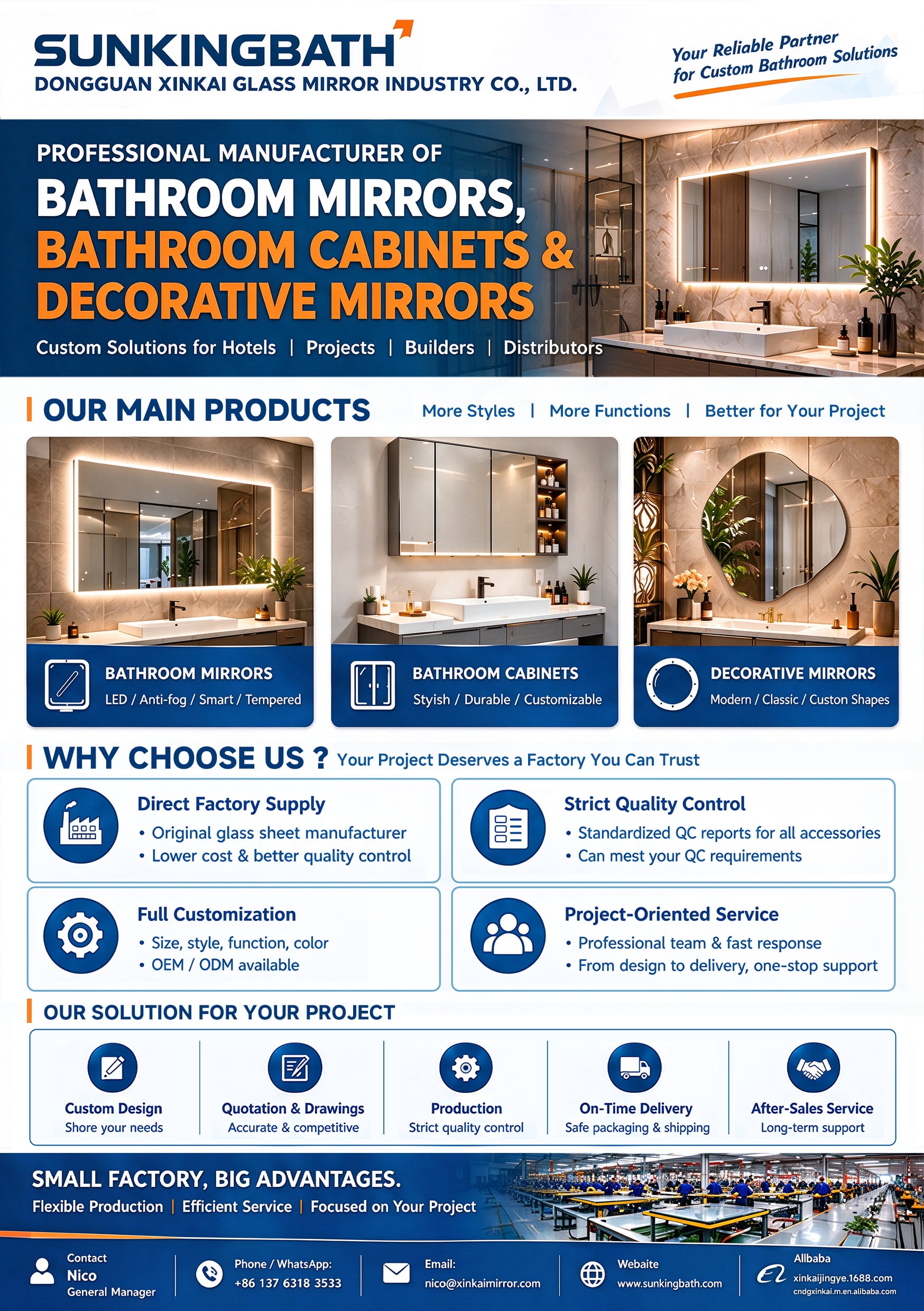
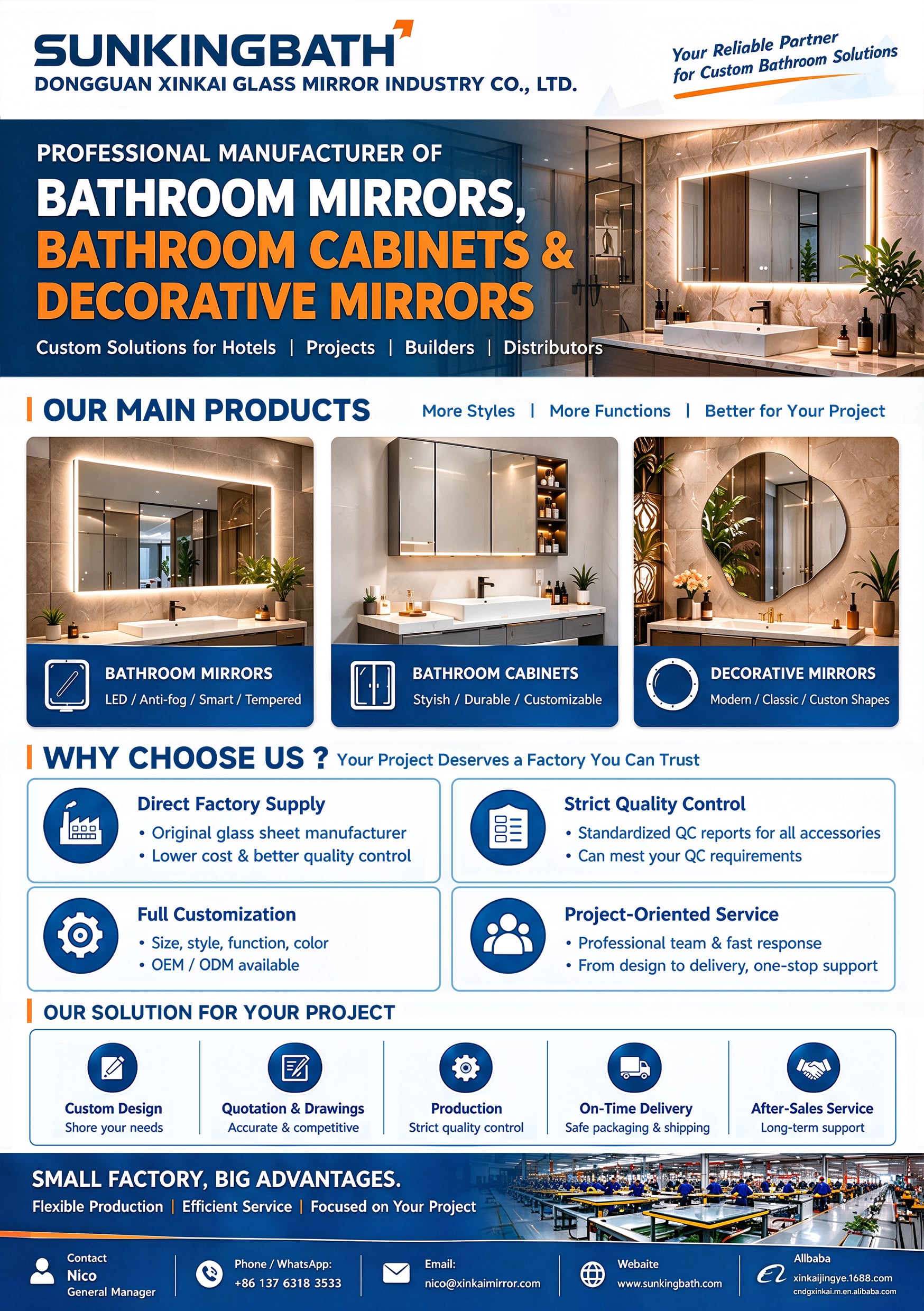
We have been making bathroom mirrors, mirror cabinets and decorative mirrors for hotels, contractors, builders and distributors for over 30 years, shipping to more than 50 countries and several hundred project cases along the way. The buyers who end up happy are almost always the ones who specify like an engineer and schedule like a project manager. What follows is the checklist we send to new customers before we price a single unit.
A hotel bathroom is a wet room with a fixed layout, and the mirror has to survive it. Before size and style, settle the electrical zone. A mirror sitting within 60 cm of a shower or bath outlet needs at least IP44 protection, and if it can be splashed directly, IP65 is the safer call. That single decision removes half the models on the market and saves an argument with the electrical inspector later.
Sizing is where projects most often go wrong, usually by 100 mm. A mirror that is narrower than the vanity looks like a mistake from the doorway. As a working rule, match the vanity width, or go 50 to 100 mm wider if the wall allows. Height matters too: the centre of the mirror should land roughly 1,500 to 1,600 mm above the finished floor, and the top edge should line up with a tile course or a ceiling detail so the installer has something to aim at. Hand this number to the tiler, not just the mirror supplier.
One more thing worth writing into the schedule: who sets out the positions on site. Small deviations in tile layout turn a 20 mm tolerance into a 60 mm gap, and nobody wants to be the person who signs off on that.
Almost every mirror looks perfect on the day it is unpacked. The differences show up in month eighteen, at the edges, in a bathroom with no window and a shower running four times a day.
Specify 5 mm or 6 mm copper-free silver mirror for hotel work. Silver gives noticeably better reflectivity than the older aluminium-coated product, and copper-free backing avoids the black-edge corrosion that plagues cheap glass in humid rooms. Thickness is a structural choice as much as anything else: a 900 × 1,200 mm mirror at 5 mm will flex and distort slightly when it is leaned against a wall, while 6 mm stays flat and feels solid to the touch.
The edge is where water gets in. Ask how the manufacturer seals it, whether the backing paint runs two or three coats, and whether there is a protective film behind the silver layer. Then ask for test data. A salt spray or CASS test report is not a marketing document; it is the difference between a mirror that survives a decade of steam and one that starts creeping black from the corner within two summers.
If the project is coastal, say so on the enquiry. Salt in the air changes the conversation about edge sealing and about the metal fittings behind the glass.
Lighting is the part of a hotel mirror that guests judge without knowing they are judging it. Four numbers cover most of the risk.
Colour rendering. Aim for CRI 90 or above. Below that, skin tones go grey under the light and guests notice, even if they cannot say why. Colour temperature. 3000K for guest rooms, 4000K for public washrooms, and keep one temperature per room type so the corridors do not clash with the bathrooms. IP rating. IP44 minimum in the mirror body, and check the driver separately, because a sealed mirror with an exposed driver is only half protected. Driver quality. A mirror with a five-year life and a two-year driver is a two-year mirror. Ask for the driver brand and its rated hours.
Demister performance is usually quoted as a wattage, and wattage is a poor proxy for results. A 30 W pad spread across a 1.2 m² mirror clears a hand-sized patch; the same power concentrated behind the centre clears a usable area. Ask where the pad sits and how many minutes it takes to clear at 20°C room temperature.
Sensors deserve a mention too. Touch buttons fog up and confuse housekeeping, and a rocker switch on the mirror face collects toothpaste. A wall switch outside the mirror, or a touch sensor with a capacitive layer behind the glass, is the more durable choice in a hotel setting.
Once a project moves from mirrors to cabinets, moisture becomes a materials problem. Standard MDF swells and loses its screw-holding strength after a few wet seasons. Specify moisture-resistant board with sealed edges, or plywood, or an aluminium carcass if the budget allows and the design suits it.
Hinges are the second weak point. Branded hinges from Blum, Hettich or an equivalent tier cost a few dollars more and are the difference between a door that still sits square in year five and one that hangs 5 mm low with the guests noticing. Soft-close is standard now; adjustable hinges are not, and they should be, because site walls are never perfectly plumb.
Plan the internals before the exterior. Shaver sockets, spare toilet rolls, hairdryers, and the pipework behind the unit all need somewhere to live. A 150 mm service gap at the back of a wall-hung cabinet costs almost nothing at design stage and saves a plumber's afternoon later. If the cabinet is wall-hung, confirm what is behind the wall: timber studs, blockwork or drywall with a bracket system all change the fixing detail.
Prices for the same drawing can vary by 40% between suppliers, and the difference is nearly always in the parts you cannot see in a photo. Use the same seven questions with every factory and compare the answers side by side.
| What to ask | What a good answer sounds like | Red flag |
|---|---|---|
| Glass source and type | Named glass supplier, copper-free silver, stated thickness | "High quality mirror glass" |
| Edge treatment | Sealed and painted, test report available | "Polished edge" only |
| LED driver | Brand and rated hours quoted | No brand, "CE driver" |
| QC process | Written report per batch, with photos | "We check every piece" |
| Packing | Crate spec, foam thickness, drop test | "Strong export packing" |
| Custom work | Own tooling, OEM/ODM, drawing approval | "We can do any design" |
| Lead time | Sample and production dates in writing | "Fast delivery" |
Two smaller points that reveal a lot. First, ask what happens when a unit arrives broken. A supplier who ships 2% spares without being asked has done hotel work before. Second, ask for the drawing of your mirror, dimensioned, before production. If the factory cannot produce a drawing, the installer is working from a photograph, and that is how 30 mm errors become site visits.
There is a real trade-off here, and the honest answer is that it depends on the order.
A direct manufacturer, particularly one that starts from raw glass sheet, controls the parts that drive quality: glass selection, coating, edge sealing, and the QC step at the end. Custom sizes and non-standard shapes are cheaper because no one is adding a margin on top of a factory price, and problems are solved by the people who actually run the line. For a hotel rollout of several hundred units, that difference compounds.
A trading company earns its place on small, mixed orders, when a project needs mirrors plus accessories plus sanitaryware from one invoice, or when a buyer needs someone to chase several factories on their behalf. What it cannot do is give you control over the process it does not own.
Either way, ask who makes the glass and who assembles the LED. If both answers are "us", you are talking to a manufacturer.
Mirrors break in transit more often than they break in service, and the cause is usually the same: a carton that survives a courier but not a container.
For export, expect individual foam-lined cartons, corner protectors, and a plywood crate for anything above roughly 1 m². Ask for the drop test the factory uses and the crate dimensions, because crate size drives container loading and container loading drives freight cost per unit. A 40HQ holds far fewer crates than most first-time buyers estimate, and the difference between 6 mm and 5 mm glass can change the count.
Schedule matters as much as packing. On multi-floor hotel projects, deliveries sequenced by floor reduce double handling and site damage. Send the room numbering with the purchase order, and ask the factory to label crates accordingly. It costs a label and saves a week.
Finally, keep a small buffer of spares on the last container. Not because the mirrors are fragile, but because fitting teams drop things, and a replacement shipped six weeks later delays a floor opening.
Samples usually take 7 to 12 days once the drawing is approved, and production runs 25 to 35 days depending on size mix, LED configuration and the finishing schedule. Add transit time from Shenzhen or Guangzhou, which is four to six weeks to Europe or North America by sea. The realistic planning number for a hotel project is 12 weeks from approved drawing to site, and that is the number to put in the programme.
It depends on whether the size requires new tooling or a different driver. Standard sizes in moderate quantities are straightforward. Custom shapes, unusual frame profiles or a new sensor specification need a bit more volume to make the setup worthwhile. Ask early: a 50-piece trial and a 500-piece rollout are priced on different logic, and knowing which one you are buying changes the quote.
Yes, and it is one of the more common requests we get. Send a photo plus the critical dimensions and the finish reference, and the design can be redrawn into a production drawing for approval. What cannot be matched from a photo is the glass spec, so treat the visual match and the material spec as two separate conversations.
We would encourage it. Dongguan is roughly 65 km from the Canton Fair complex, about 1.5 to 2 hours by car, and about an hour and a half from Guangzhou South station. Buyers who walk the line usually leave with a shorter spec sheet and fewer questions, because they have seen which parts are worth paying for.
Custom bathroom mirrors are not a complicated product, but they are an unforgiving one. The failures are slow, visible and expensive to fix once a hotel is open: black edges, flickering drivers, doors that hang crooked, a mirror that is 100 mm narrower than the vanity beneath it.
Almost all of it is preventable at the quotation stage with a spec sheet that names the glass, the sealing, the driver, the IP rating, the packing and the delivery sequence. That sheet takes an afternoon to write. It is the cheapest insurance in the whole project.
If you are working on a hotel, serviced apartment or residential development and want a second opinion on a specification, send the drawing and the room schedule. We will tell you what we would change before we tell you what it costs.
SUNKINGBATH — Dongguan Xinkai Glass Mirror Industry Co., Ltd. Bathroom mirrors, mirror cabinets and decorative mirrors for hotels, projects, builders and distributors. 30+ years of export experience, 50+ countries, OEM and ODM available.



 EN