A mirror can look perfect in a product catalog and still be the wrong choice for a real project.
This happens more often than many buyers expect.
An LED bathroom mirror designed for a private home may not be suitable for a hotel. A mirror that works well for a small renovation project may not be practical for a 500-unit apartment development. And a product that sells successfully in one market may require changes before it can be supplied to another.
From a factory perspective, this is one of the biggest differences between standard mirror sales and project manufacturing.
The project determines the mirror—not the other way around.
Hotels usually have a consistent visual style across multiple rooms.
The bathroom mirror needs to match the vanity, wall dimensions, lighting design, and overall interior concept. More importantly, hundreds of rooms may require the same product.
That creates a different manufacturing requirement.
For example, a hotel project may need:
The same mirror design across hundreds of rooms
Several sizes for different room types
Consistent LED lighting
Stable electrical components
Easy installation
Strong transportation protection
Repeat production months later
The challenge is not producing one attractive mirror.
The challenge is producing hundreds of mirrors that remain consistent.
This is why hotel projects often require a manufacturer that understands repeat production rather than simply supplying products from a standard catalog.
Multi-unit residential projects can look simple from the outside.
There may be hundreds of bathrooms, and the buyer may think that ordering one mirror model in bulk will solve everything.
In practice, different apartment layouts often require different dimensions.
A smaller bathroom may need a compact rectangular mirror.
A larger master bathroom may require a wider model.
Some units may use double vanities, while others have a single vanity.
The buyer may therefore need one product family with several dimensions instead of completely unrelated mirror models.
This is where customized production becomes useful.
A factory can develop different sizes while keeping the overall appearance, lighting concept, and functional configuration consistent.
For developers and contractors, this can simplify both product selection and installation.
Commercial bathroom projects can introduce another consideration: the mirror has to work with the surrounding environment.
The vanity, wall, lighting, electrical outlet, cabinet, and mirror may all be specified before production begins.
A few centimeters can make a difference.
For example, the original mirror design may be 900 mm wide, but the actual installation area may require a slightly different dimension.
With a standard retail product, the buyer may have to change the installation.
With a manufacturer capable of custom production, the product can potentially be adjusted to the project.
That is a very different way of approaching procurement.
Instead of asking:
“Which mirror do you have?”
The conversation becomes:
“What does your project require?”
When people hear “custom LED bathroom mirror,” they often think about changing the dimensions.
Size is only one part of customization.
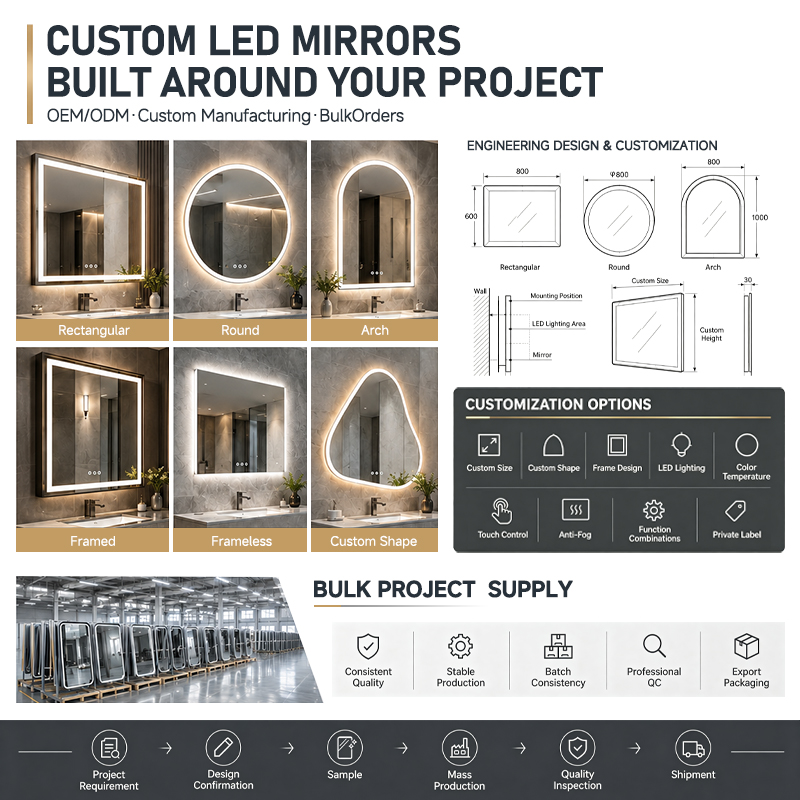
Depending on the project, customization can involve:
Appearance
Frame or frameless construction, shape, edge treatment, and overall visual style.
Lighting
Backlighting, front lighting, different color temperatures, dimming, or other lighting configurations.
Controls
Touch switches, sensor controls, and different combinations of smart functions.
Functions
Anti-fog systems, time and temperature displays, or other project-specific features.
Branding
Logo application, packaging, and private-label requirements.
The important point is that not every project needs every feature.
A good project solution is usually the result of selecting the right combination.
Adding unnecessary functions can increase cost without adding meaningful value to the project.
For a B2B order, the sample is not simply a demonstration of what the product looks like.
It can become the reference point for mass production.
Once the buyer approves the sample, the manufacturer needs to reproduce the agreed specifications consistently.
This is particularly important when the project has a large quantity.
A professional sample confirmation can cover:
Mirror dimensions
Shape
LED position
Lighting effect
Color temperature
Switch location
Function configuration
Frame details
Mounting method
Logo and packaging
The goal is simple:
The production team should know exactly what has been approved.
This reduces misunderstandings between sales, engineering, production, and the buyer.
Producing 10 mirrors and producing 1,000 mirrors are not simply different quantities.
The production process itself becomes more important.
With larger orders, the manufacturer needs to manage:
Material preparation
Production scheduling
Component consistency
Assembly procedures
Electrical testing
Quality inspection
Packaging
Warehouse coordination
Shipment planning
A project buyer therefore needs to think beyond the first delivery.
What happens when another batch is required six months later?
Can the same specifications be reproduced?
Can the manufacturer maintain the same appearance and functions?
Can the buyer reorder without starting product development from zero?
For distributors and private-label brands, these questions can be even more important than the first order.
There are many companies that can sell an LED bathroom mirror.
There are fewer manufacturers that have spent decades dealing with different mirror specifications, production requirements, export packaging, and custom orders.
At Sunkingbath, mirror manufacturing has been our focus for more than 30 years.
That experience means we have worked with different product structures, sizes, lighting configurations, and customer requirements.
Not every project needs the same solution.
Sometimes the best solution is a simple standard model.
Sometimes the project requires custom dimensions.
Sometimes a buyer needs a complete OEM/ODM product line.
The role of the manufacturer is to understand the difference.
Distributors have another challenge.
They need products that are suitable for their own market and customer base.
Instead of supplying one product, they may need a collection.
For example:
Series A
Simple LED bathroom mirrors for standard projects.
Series B
Mirrors with additional functions for higher-end developments.
Series C
Customized models for hotel or commercial projects.
This allows a distributor to serve different customer groups without managing completely unrelated suppliers.
OEM and ODM manufacturing can make this type of product strategy easier to develop.
For a private-label brand, the manufacturer's role goes beyond production.
The mirror becomes part of the brand's product identity.
The shape, frame, lighting effect, switch design, packaging, and logo all need to remain consistent.
If the product changes every time an order is placed, customers notice.
This is why private-label buyers should consider the manufacturer's ability to maintain specifications over time.
A reliable OEM relationship is built around repeatability.
One thing we have learned from years of manufacturing is that many project problems start before production begins.
The issue may be an unclear drawing.
Or a dimension that was never confirmed.
Or a function that was added too late.
Or packaging that was considered only after the product was finished.
These problems are easier to prevent when the manufacturer becomes involved early.
That is why we encourage project buyers to discuss their requirements before finalizing the product.
Even basic information can help:
Project type → Quantity → Dimensions → Functions → Target market → Installation requirements → Delivery schedule
From there, the product can be evaluated and adjusted before mass production.
An LED bathroom mirror is still a mirror.
But once it becomes part of a hotel, apartment, commercial, renovation, or private-label project, the requirements become much broader.
The buyer is no longer purchasing only glass and LED lighting.
They are purchasing a production solution.
That solution needs to connect product design with manufacturing, quality control, packaging, customization, and delivery.
This is where an experienced LED bathroom mirror manufacturer can provide value.
At Sunkingbath, we support hotel projects, commercial projects, distributors, renovation companies, contractors, and private-label brands with standard and customized LED mirror manufacturing.
With more than 30 years of manufacturing experience, our focus is not simply to provide a mirror from a catalog.
We build the mirror around the project.
If you are planning a hotel, commercial, residential, renovation, or private-label project, send us your required dimensions, quantity, functions, and project specifications. We can discuss the appropriate LED bathroom mirror solution for your order.
Can you produce different sizes for the same LED bathroom mirror design?
Yes. Different dimensions can be developed within the same product concept, depending on the project requirements and production specifications.
Do you manufacture LED bathroom mirrors for hotels?
Yes. We support hotel and commercial projects requiring customized specifications and bulk production.
Can I customize the LED lighting?
Lighting configuration can be customized according to the product design and project requirements, including different lighting arrangements and color temperatures.
Do you support private-label LED bathroom mirrors?
Yes. OEM/ODM services can include product customization, logo application, packaging, and selected functional configurations.
Can you make a mirror according to our project dimensions?
Custom dimensions can be discussed based on the installation space and required product specifications.
What information should I send for a project quotation?
The most useful information includes quantity, dimensions, functions, project type, destination market, and expected delivery schedule.


 EN
EN